
Mold removal sounds like a single task, but a job done properly is a chain of steps, and the order matters more than the products used. This page explains what mold removal and mold remediation involve in a typical Pittsburgh house, which materials come out and which stay, why the shortcuts people try first usually fail, and what to ask any company before you agree to work. It is written for homeowners, landlords and buyers, and it says plainly when you do not need a professional at all.
If you are still working out whether what you have is mold, or where it is coming from, start with mold inspection and testing. If the problem is in one room, the pages on basement mold removal and attic mold removal go further into those spaces.
Removal and remediation are the same job with two names
You will see both words. Remediation is the term used in industry standards, and it means returning a building to its normal condition, where mold spores exist at ordinary background levels but nothing is growing. Removal is the everyday word for the same thing. Nobody can remove every spore from a house, and a company that promises to is promising something that cannot be measured. The honest goal is no active growth, no damp material feeding it, and a clean work area.
The main industry reference is ANSI/IICRC S520, the standard for professional mold remediation. It describes three conditions: normal fungal ecology, settled spores that drifted from somewhere else, and actual growth. Cleaning up settled dust is a different and lighter job than removing a wall that has been growing mold for a year. A good quote tells you which condition the specialist found.
When you do not need a company
The EPA's guidance for homeowners gives a rough line: a patch smaller than about ten square feet, on a hard surface, in a house where nobody has a health reason to avoid mold exposure, is a reasonable do-it-yourself cleanup. A shower ceiling, a window frame, a bit of growth on a painted basement wall: scrub with detergent and water, dry the surface completely, wear gloves, eye protection and an N95 respirator, and fix the reason it got wet.
You need more than a scrub brush when any of these is true:
- The growth is on or in drywall, plaster, insulation, carpet, ceiling tile or other porous material. These soak mold in and cannot be cleaned, only removed.
- The area is larger than a few square feet, or it keeps coming back after cleaning.
- The mold is inside a wall, under flooring or above a ceiling, where you can smell it but not reach it.
- Someone in the home has asthma, allergies, a lung condition or a weakened immune system. People with those conditions should not be the ones disturbing mold.
- The water was sewage or floodwater, not clean water from a pipe. That changes what is safe to handle.
The sequence of a proper job
The details vary with the size of the job, but the order does not.
1. Fix the water first. Mold needs moisture, and almost every mold problem is a water problem wearing a different coat. A leaking pipe, a failed window well, a bath fan venting into an attic or a basement wall that seeps after rain has to be repaired, or the cleaned area will grow mold again. A specialist who starts cutting before asking where the water came from has skipped the most important question.
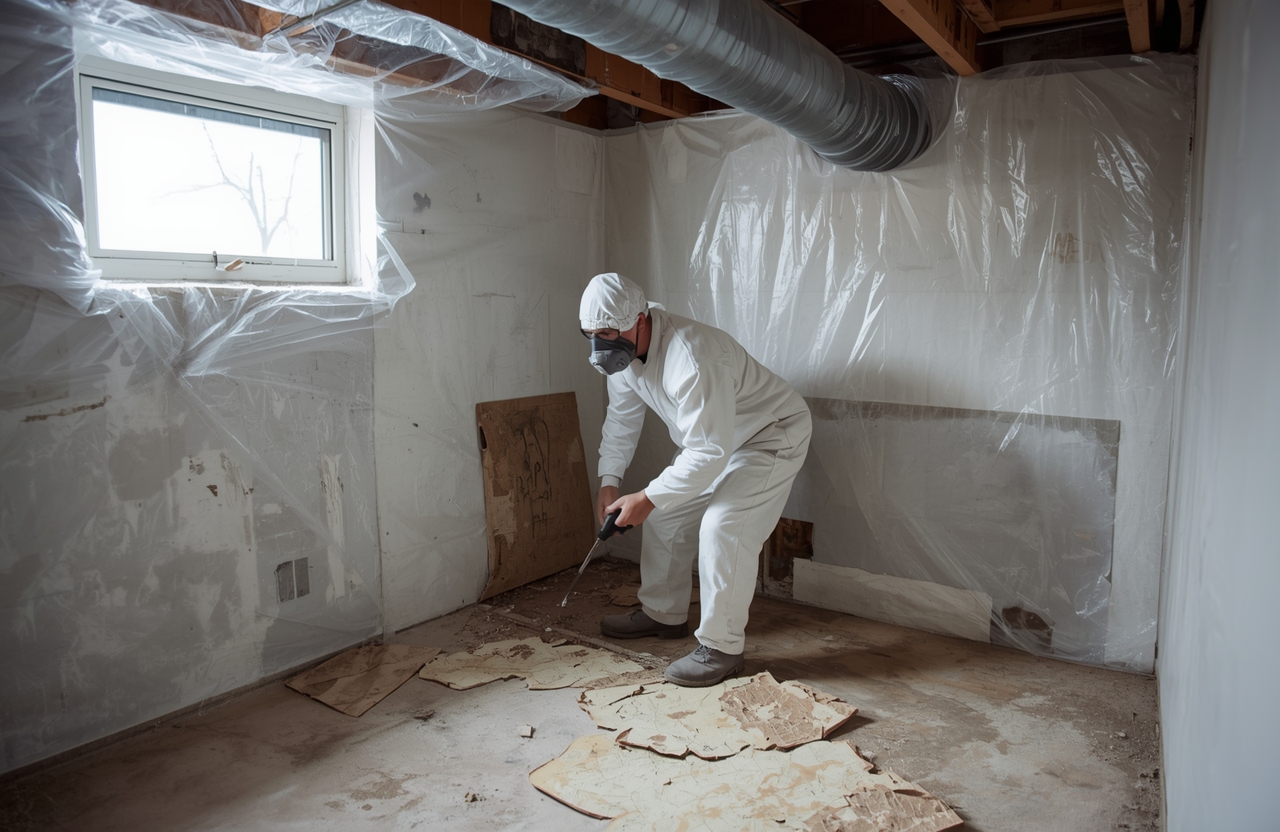
2. Seal the work area. Disturbing mold throws spores into the air. Plastic sheeting taped across doorways and openings keeps them in the work zone, and on larger jobs the zone gets a zipper door and a small airlock. This is called containment. Heating and cooling vents in the area are covered or shut so the system does not carry dust through the house.
3. Filter the air. A HEPA air scrubber, which is a filtered fan, pulls air out of the sealed area and exhausts it outside or through the filter. On many jobs it also holds the area at slightly lower pressure than the rest of the house, so air leaks inward rather than out. The work crew wears disposable coveralls, gloves and respirators.
4. Remove what cannot be saved. Porous materials with active growth are cut out and bagged in plastic while still inside the containment, then carried out. Drywall is usually removed a bit beyond the visible edge, and in a wet basement often a foot or two above the water line. Wet insulation goes. Carpet and pad that stayed damp for more than a day or two usually go.
5. Clean what can be saved. Framing lumber, concrete, block and stone are not removed, they are cleaned. Wood is typically wire-brushed or sanded to take off the growth, then vacuumed with a HEPA vacuum, then wiped. Heavy staining that remains after cleaning is a cosmetic matter if the wood is sound and dry.
6. Dry it completely. Fans and dehumidifiers bring the structure back to a normal moisture reading. A moisture meter is the proof. Closing a wall over wood that still reads wet is how the job gets repeated.
7. Check the result. A careful final look, moisture readings and, on larger jobs, a clearance test, discussed below.
What stays and what goes
Pittsburgh houses are a mix of materials, and the mix changes the answer.
Drywall. Almost always replaced when it has growth, because the paper facing feeds mold and the gypsum soaks up water.
Plaster and wood lath. Older houses in the city and the inner suburbs often have plaster over wood strips instead of drywall. Plaster itself is not very food for mold, but the lath, the paint and any wallpaper behind it can be. Removal means demolishing a heavier, dustier material, and in houses built before the late 1970s it raises the lead and asbestos questions covered further down.
Insulation. Fiberglass batts that were wet or moldy are discarded. Blown-in cellulose in an attic is a similar story if it is stained or damp. Sprayed foam is a case-by-case question for the specialist.
Framing. Joists, studs and rafters are cleaned. Wood that is soft, crumbling or rotted is replaced by a carpenter, which is a separate trade from mold work.
Concrete, block, brick and fieldstone. Cleaned and dried, not removed. A rough stone foundation wall can hold a lot of moisture, which is why basement jobs focus on stopping the water, not just wiping the stone.
Carpet, upholstery and contents. Hard goods can usually be cleaned. Soft goods that grew mold are often thrown out. Photograph what leaves the house before it goes, especially if an insurance claim may follow.
Ductwork. If mold grew inside a heating or cooling duct, that needs a specialist who cleans or replaces ducts. A general visible-mold job does not automatically include ducts.
Black mold, in this context
People search for black mold removal because the color alarms them. Color does not identify a species. The same species can look green, gray, brown or black depending on what it grows on and how old it is, and plenty of harmless molds are black. The CDC does not recommend identifying the type of mold in a home, because the cleanup and the repair are the same whatever it is. If you can see mold, the useful questions are how much, where, and why that spot got wet.
Mold with a dark color gets removed the same way as any other: contained, cut out or cleaned, and checked. Nothing about a dark stain justifies a special product or a higher price on its own. A person who says a black patch needs an emergency response, or who quotes a different price for the same job because of its color, deserves a second opinion. Medical questions belong to a doctor; some people react to mold more than others, and anyone with asthma or a weakened immune system should keep away from disturbed mold.
The shortcuts that usually fail
Bleach. The EPA does not recommend routine use of bleach for mold. On porous materials it cleans the surface while the water in it feeds growth deeper in, and it does nothing about the moisture source. It is also hard on lungs in a closed basement.
Fogging and "mold bombs". A fog of antimicrobial chemical in a room treats the air and surfaces, not the growth inside a wall, and it does not replace removal. It can leave residue.
Painting over it. Encapsulating or mold-resistant paint over live growth hides it. The growth keeps going under the film and the paint peels.
Fans alone. A box fan in a damp basement moves humid air around. Drying a structure takes dehumidification and measured readings.
Cleaning without fixing the leak. This is the most common reason a mold job fails. If the wall is wet again in three months, the growth will be too.
Older Pittsburgh houses: lead and asbestos before demolition
A large share of the homes in Pittsburgh and the older suburbs were built before 1978, and many before 1950. Removing plaster, flooring, pipe wrap or old paint in a house that age can disturb materials that are regulated on their own.
For lead paint, federal rules require contractors who disturb paint in pre-1978 housing to be certified for lead-safe work practices under the EPA's Renovation, Repair and Painting rule. Ask any company working in an older home whether its crew follows that rule.
For asbestos, older pipe insulation, some floor tile, some plaster and vermiculite attic insulation can contain it. In Allegheny County the Allegheny County Health Department enforces air quality rules on asbestos in renovation and demolition, while the state Department of Environmental Protection covers the rest of Pennsylvania. A responsible company asks about the age of the house before it demolishes anything and tests suspect material when it matters. This is a good reason to have the specialist look at the house before cutting, not after.
Who does the work in Pennsylvania
Pennsylvania has no state license for mold inspection or mold remediation. That means a license number is not the thing to look for, and a company that advertises one is probably referring to something else. What does exist:
- Industry training and standards. Technicians may hold credentials from groups such as the IICRC and the ACAC, and a good company follows ANSI/IICRC S520. Ask which credentials its people hold and for the number, and check it with the group that issued it.
- Home improvement registration. Under the state's Home Improvement Consumer Protection Act, contractors doing residential work over $500 have to register with the Pennsylvania Attorney General, and the registration number belongs on the written contract. You can look a number up on the Attorney General's website.
- A written contract. For residential work above $500 the contract should be written and say what work will be done, the price, the start and finish estimates and the contractor's registration number. In most cases the law limits how large a deposit can be, roughly a third of the price, so be wary of anyone asking for much more up front.
- Insurance. Ask for proof of liability coverage, not a promise.
This site does not do the mold work itself. Calls and requests are handled by an independent local company, named at the bottom of every page, and the same questions above are fair to ask it.
What a good quote contains
- The moisture source found, and who is fixing it.
- A written scope: which rooms, which materials come out, how many square feet and how the area will be sealed.
- Whether air machines and HEPA vacuums are part of the price.
- What happens to demolished material and how contents are handled.
- Whether a clearance test is included, and who performs it.
- A price, a timeline and a registration number on the contract.
Get a second quote on anything large, and be cautious about a quote given sight unseen from a phone call alone. The specialist cannot know what is behind a wall.
Who checks the work
On a larger job, the best check is a clearance test by someone independent of the company that did the removal, because the remover grading its own work is a conflict of interest. Clearance is usually a visual inspection plus air or surface sampling compared with an outdoor reference sample. On a small job, a careful visual check and moisture readings may be enough. Decide before the job starts who will do the check, and write it into the scope.
What it costs, in general terms
Prices vary a lot with the size of the area, the materials and how hard the space is to work in, and the specialist quotes after seeing the job. As a rough, national idea: a small, contained area can run from a few hundred dollars to a couple of thousand, while a basement, an attic or a whole-house job with demolition, containment and rebuild can reach several thousand or more. Rebuilding drywall, flooring and paint is usually a separate cost from the mold work.
Insurance and mold
Coverage for mold is often narrower than people expect. Many homeowner policies cover mold only when it follows a sudden covered event, such as a burst pipe, and exclude mold from slow seepage, humidity or lack of maintenance. Policies differ, and some cap mold coverage at a set amount. Read yours or ask your agent before the work starts, document the damage with photos, and keep receipts. Whoever you call cannot tell you what your policy covers.
Where to go next
If you are not sure the problem is mold, read mold inspection and testing. If water caused it, see water damage restoration. The guides cover basement mold in older Pittsburgh homes and what to do after a basement flood, and the service areas page lists the Pittsburgh suburbs covered with local notes for each.