
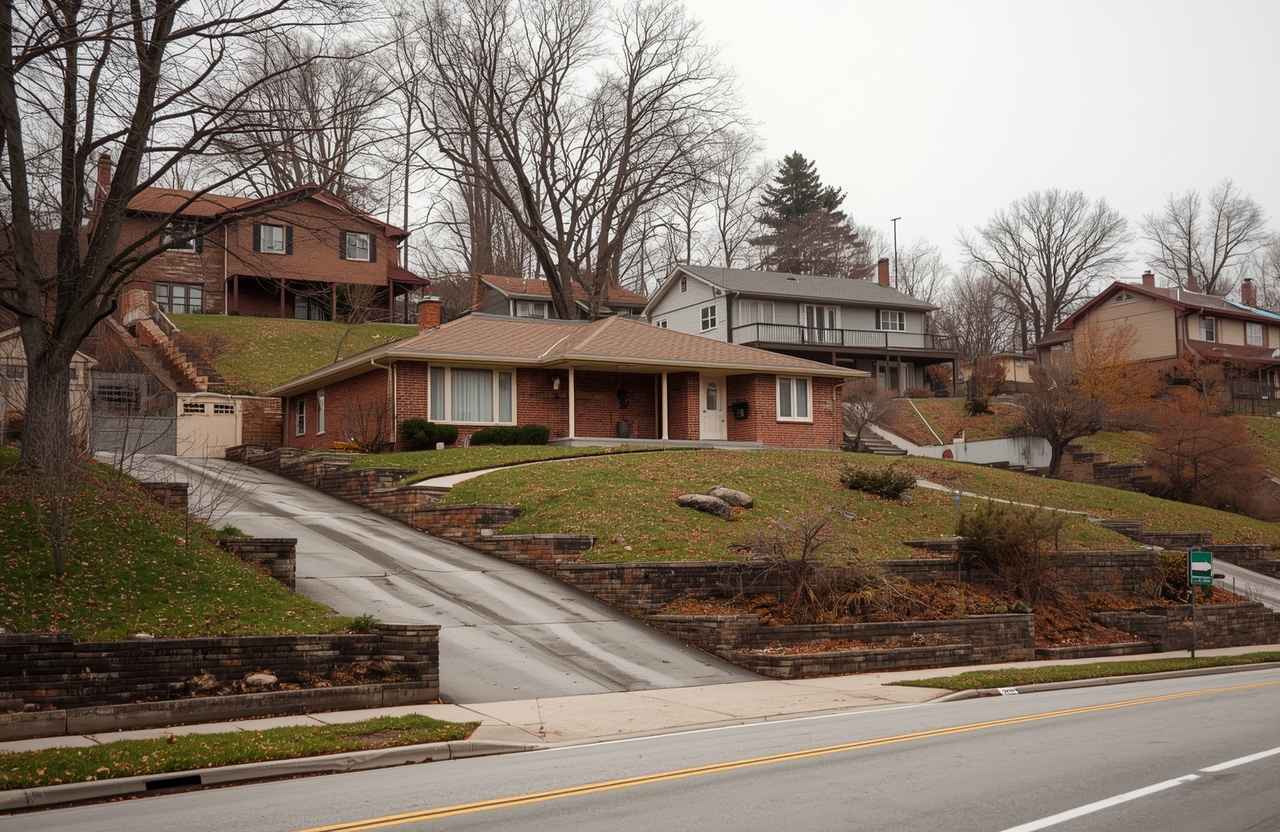
Bethel Park sits in the South Hills, where the land rolls and a house is rarely on a flat lot. Most of its housing was built from the 1950s through the 1970s, and it shows in the styles: brick ranches, split-levels, bi-levels and tri-levels with attached garages. Those houses are sturdier against moisture in some ways than a 1920s cellar and more exposed in others. This page looks at what that means for mold.
The shape of the house changes where the water goes
In a ranch or split-level on a slope, part of the house is often partly underground and part is at grade. A lower-level family room may have one wall fully below the soil on the uphill side and a door or large window at ground level on the downhill side. That arrangement puts a heavy load of soil and rainwater against one wall and leaves the opposite side dry.
Water follows the slope. After a long rain or a snowmelt, water that runs downhill toward the house finds the foundation wall, the window wells and the joint between the floor slab and the wall. When a house like this has damp walls on only one side, the cause is usually surface drainage or groundwater on that side, not humidity.
Common trouble spots
Below-grade family rooms. Many split-levels have a finished room carved into the hillside, with paneling or drywall on framing against a block wall, carpet on a slab and a drop ceiling. Moisture moves through the block, behind the framing and into the carpet, and mold grows where no one can see. The signs are a musty smell, carpet that feels cool and damp, and stains low on the wall. The page on basement mold removal describes how this is checked and fixed.
Slab and crawl-space areas. Parts of some houses sit on a slab with no basement, and additions are often built over a crawl space. Slab areas can sweat in summer when a cold floor meets humid air, and crawl spaces with bare soil put moisture up into the floor above. Both are worth a look if the floors feel damp or smell.
Garage-level utility rooms. A laundry or furnace room at garage level can pick up water from the driveway slope. A drain in the garage floor that is blocked or ends nowhere moves water toward the interior.
Retaining walls and hillside soil. Western Pennsylvania has clay-rich soils that hold water and move slowly downhill over years. Stone and block retaining walls, steps and landscape beds that were built on that ground can redirect water toward the house or fail, which then changes how water behaves near the foundation. If a wall started leaking after a landscape change, start there.
Bi-level entries and stairwells. A stairwell down to a lower entry can fill with rainwater if its drain clogs, wetting the door threshold and the wall around it.
Drainage fixes before anything else
For a house on a slope, outside fixes are often the first and most worthwhile money spent:
- Make sure gutters are clean, large enough and not overflowing at the corners.
- Carry downspouts well away from the house, on the downhill side if possible, in a buried pipe where the slope allows it.
- Check the grade next to the wall and the driveway and walks, and redirect surface flow away from the foundation.
- Clear stairwell and window well drains and add covers.
- Check any surface or French drain that was installed years ago, since they clog.
If water is still getting in, a waterproofing contractor can discuss interior drain tile and a sump pit or exterior work. That is separate from mold work, and it is worth getting more than one opinion.
Sump pumps and the power question
Houses with a sump pit depend on one pump and one power supply. Storms often arrive with outages, so a battery backup is worth considering, and so is a water alarm that sounds if the pit rises. Check the float and the discharge line twice a year. A discharge that empties at the foundation just recirculates water into the pit.
Radon and sealing
Pennsylvania has high radon levels in many places, and some South Hills houses have a radon fan and pipe through the slab. These do not cause mold, but a sealed, mechanically ventilated basement can trap humid air in summer. A dehumidifier with a hose to a drain and a humidity reading kept between 30 and 50 percent handles it.
Buying or selling a Bethel Park house
Hillside houses deserve a careful inspection of the lower level before an agreement of sale is signed. Ask the seller about water in the basement or lower level and look for fresh paint on one wall, a new dehumidifier running in the corner, new baseboards or paneling and a musty smell masked with air freshener. The guide on mold when you buy or sell a house explains how the inspection timeline usually works and how mold findings are handled.
What a specialist should do here
A good visit begins outside, walks the grade, checks the gutters and drains and then goes in. The specialist reads moisture on the low walls on both the uphill and downhill sides, checks carpet and the slab edge, looks in the garage-level rooms and asks about past water and repairs. A recommendation should name the moisture source and say whether the next step is a drainage fix, a drying job or removal. See mold inspection and testing for what a visit includes and mold removal for the removal steps.
Nearby
Housing in Mt. Lebanon is older and more compact, and Upper St. Clair has larger, newer houses on the same kind of slopes.